



Manatees in Mexico: Where to See Them Near Riviera Maya
Manatees live year-round along Mexico’s Caribbean coast. One of the best places for a wild sighting near Riviera Maya is the Sian Ka’an Biosphere Reserve, south of Tulum.
Seeing a manatee in the wild can be one of the most memorable wildlife experiences in the Yucatan Peninsula. These slow-moving marine mammals live in warm, shallow waters, particularly around mangroves, lagoons and sheltered bays.
If you’re staying in Riviera Maya, several of Mexico’s best-known manatee habitats are within reach. The region is also home to an impressive variety of Mexican animals and wildlife, making it easy to add a wildlife experience to your beach vacation.
Where to See Manatees in Mexico Near Riviera Maya
Manatees prefer calm, shallow waters around mangroves, lagoons and river mouths. According to the U.S. Fish & Wildlife Service, Antillean manatees inhabit marine, brackish and freshwater environments and are commonly associated with coastal areas rich in aquatic vegetation.
Along the Caribbean coast of Quintana Roo, several destinations offer opportunities to see them:
- Sian Ka’an Biosphere Reserve: One of the best options for seeing manatees in their natural habitat.
- Bacalar and Chetumal Bay: A quieter option farther south, close to an important manatee sanctuary.
- Banco Chinchorro and Xcalak: Remote destinations better suited to travelers combining wildlife spotting with diving or snorkeling.
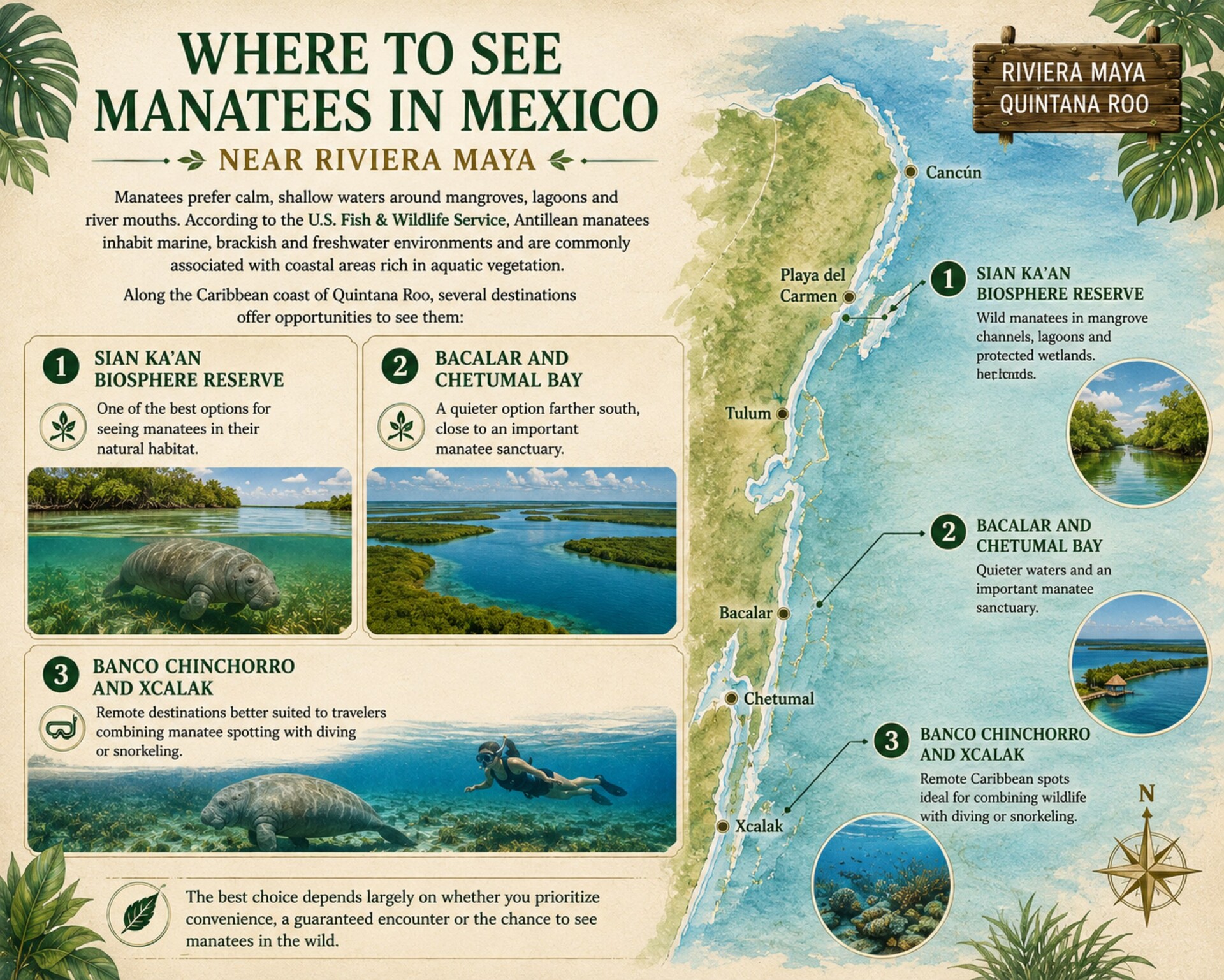
The best choice depends largely on whether you prioritize convenience, a guaranteed encounter or the chance to see manatees in the wild.
Sian Ka’an: One of the Best Places to See Wild Manatees
For travelers staying in Riviera Maya, Sian Ka’an is one of the most accessible places to look for wild manatees.
Boat tours travel through the reserve’s lagoons and mangrove channels, where visitors may also spot crocodiles, tropical birds, dolphins and other wildlife.
The reserve is also home to mammals such as spider monkeys and howler monkeys. If spotting monkeys is on your list, discover more about where to see howler monkeys in Riviera Maya.
Because wildlife moves freely throughout the reserve, sightings are never guaranteed. That uncertainty, however, is part of what makes seeing a manatee here so special.
Sian Ka’an is a UNESCO World Heritage Site protecting more than 500,000 hectares of tropical forests, wetlands, mangroves and marine ecosystems.
Bacalar and Chetumal Bay
Travelers with more time can continue south toward Bacalar and Chetumal Bay.
Quintana Roo established a dedicated manatee sanctuary in Chetumal Bay in 1996 to help protect the area's population and habitat.
It requires a considerably longer journey from Playa del Carmen, so combining a visit with Bacalar is generally more practical than trying to fit everything into a rushed day trip.
The reward is a quieter experience away from many of Riviera Maya’s busiest tourist areas.
Banco Chinchorro and Xcalak
For travelers looking for a more remote wildlife experience, Xcalak and Banco Chinchorro offer another option along the southern Caribbean coast of Quintana Roo.
These destinations are considerably farther from Riviera Maya than Sian Ka’an and are better suited to travelers planning a longer trip that combines wildlife spotting with snorkeling, diving or exploring less-developed coastal areas.
Because of the distance involved, they are generally not practical as a day trip from Playa del Carmen or Cancun. However, for travelers willing to venture farther south, they offer the chance to experience some of Quintana Roo’s quieter marine environments.
Where Should You Go to See Manatees?
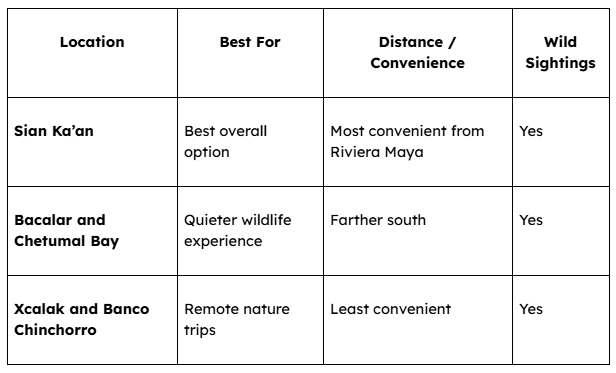
For most travelers staying in Riviera Maya, Sian Ka’an offers the best balance of accessibility and the opportunity to see manatees in their natural habitat. Bacalar, Chetumal Bay and Xcalak are better suited to travelers with more time who want to explore farther south.
How to See Manatees Responsibly
Seeing a manatee in the wild is a special experience, but protecting the animal and its habitat should always come first.
- Keep a respectful distance: Allow manatees to move naturally without approaching, chasing or surrounding them.
- Never feed wild manatees: Feeding can change their natural behavior and make them more dependent on humans.
- Avoid touching them: Even when a manatee approaches a boat or swimmer, allow the animal to decide where it wants to go.
- Choose responsible tour operators: Look for guides that follow local conservation rules and prioritize wildlife protection.
- Keep noise and disturbance to a minimum: Sudden movements, excessive noise and crowding can disrupt wildlife.
- Respect protected areas: Follow the rules of reserves and sanctuaries, particularly around mangroves, lagoons and other sensitive habitats.
Responsible wildlife tourism helps protect Quintana Roo’s manatee populations while giving future visitors the opportunity to experience these animals in the wild.
Best Time to See Manatees in Mexico
Manatees can be seen throughout the year because the waters along Mexico’s Caribbean coast remain warm.
However, the November to April dry season generally brings calmer weather and better visibility, making boat tours more comfortable.
You can still see manatees during the summer and rainy season, although storms can occasionally affect tour schedules and water conditions.
Manatee vs. Dugong: What’s the Difference?
Manatees and dugongs are closely related marine mammals and are both commonly called sea cows, but there are several differences between them.
- Size: Manatees are generally larger, typically reaching around 9 to 10 feet in length, while dugongs tend to be slightly smaller.
- Diet: Both animals are herbivores. Manatees eat a wide variety of aquatic vegetation, while dugongs rely more heavily on seagrass.
- Habitat: Manatees can live in fresh, brackish and salt water. Dugongs live exclusively in marine environments.
- Location: Dugongs are found across parts of the Indo-Pacific. They do not live in Mexico or elsewhere in the Americas.
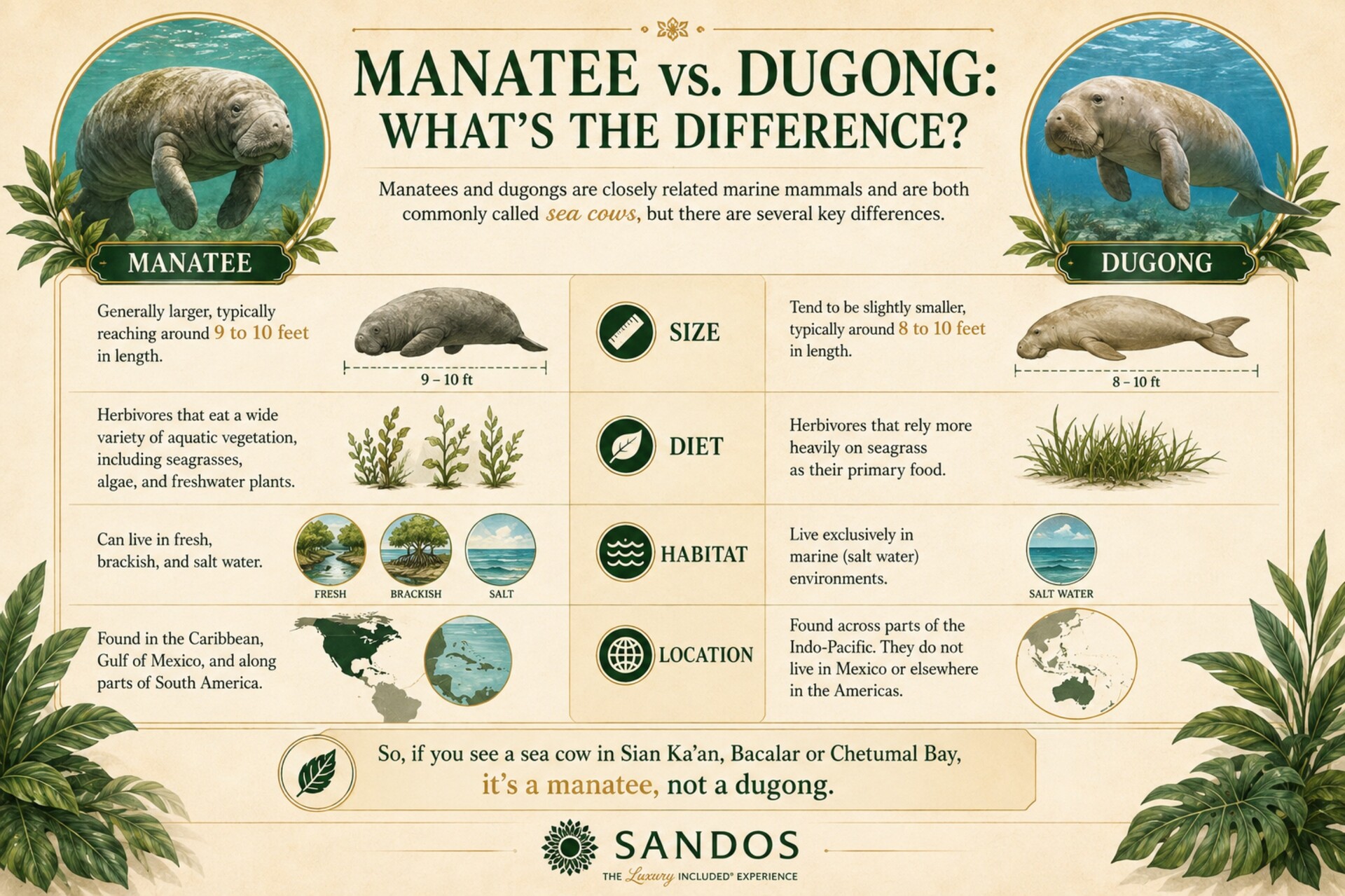
So, if you see a sea cow in Sian Ka’an, Bacalar or Chetumal Bay, it’s a manatee, not a dugong.
Tips for Planning a Manatee Tour
- Book a morning tour when possible, when conditions are often calmer.
- Bring reef-safe sunscreen when visiting protected coastal areas.
- Carry a light rain jacket during the summer and rainy season.
- Check whether transportation from your resort is included.
- Choose operators that follow responsible wildlife and conservation practices.
- Remember that wild manatee sightings can never be guaranteed.
Wildlife lovers can also look for some of the region’s hundreds of bird species. Our guide to birds in Playa del Carmen covers species you may see along the coast, in mangroves and throughout the surrounding jungle.
Guests at Sandos Caracol can also see available nature activities through the resort’s All-Nature Experience program.
Plan Your Riviera Maya Wildlife Experience
Riviera Maya makes it easy to combine a beach vacation with some of Mexico’s most memorable wildlife experiences. You can explore the mangrove channels of Sian Ka’an in search of wild manatees, head south toward Bacalar and Chetumal Bay, or discover tropical birds, monkeys, and other native species throughout the region.
And manatees are just one part of the Yucatan’s biodiversity. From tropical birds and monkeys to jaguars native to the Yucatan, there is much more to discover beyond the beaches.
Staying at Sandos Caracol, Sandos Playacar, or Sandos Cancun gives you a convenient base for exploring Riviera Maya while enjoying an all-inclusive beach vacation.
Frequently Asked Questions
Are there manatees in Mexico?
Yes. West Indian manatees live along Mexico’s Caribbean coast, including mangrove lagoons and bays throughout Quintana Roo.
Where is the best place to see manatees near Riviera Maya?
Sian Ka’an Biosphere Reserve, south of Tulum, is one of the best options for travelers hoping to see manatees in the wild.
Are manatees dangerous to humans?
No. Manatees are herbivores and are generally calm animals. However, they are still wild animals and should always be observed responsibly.
Are manatees friendly?
Manatees are generally gentle and curious, but visitors should avoid touching or approaching wild animals unless permitted as part of an authorized encounter.
Why shouldn’t you touch wild manatees?
Human interaction can disturb their natural behavior and make animals less cautious around boats and people. Responsible wildlife tours keep an appropriate distance.
What is a sea cow?
“Sea cow” is a common nickname for manatees and dugongs because they spend much of their time slowly grazing on aquatic vegetation.
Do manatees have predators?
Adult manatees have relatively few natural predators. Human-related threats, including boat strikes and habitat loss, are among their most serious risks.
How long do manatees live?
Manatees can live for around 50 to 60 years in the wild.
How big are manatees?
Adult manatees typically grow to around 9 to 10 feet long, although some individuals can grow considerably larger.
How much does a manatee weigh?
Adult manatees commonly weigh around 1,000 pounds, although particularly large individuals can weigh much more.
What do manatees eat?
Manatees are herbivores that feed primarily on seagrass and other aquatic plants.
Can manatees go on land?
No. Unlike seals and sea lions, manatees are fully aquatic mammals and cannot move onto land.
Were manatees mistaken for mermaids?
Manatees and dugongs have long been associated with mermaid legends, with historical accounts describing sailors mistaking sea cows for human-like figures from a distance.
What time of year is best for a manatee tour?
Manatees can be seen year-round, although the November-to-April dry season generally offers calmer weather and better conditions for boat tours.